Development of an Intelligent System Based on Deep Learning for Automatic Detection of Fruit Defects
کلمات کلیدی:
Fruit defects, Deep learning, based intelligent system, CBAM attention mechanism, ResNet50 networkچکیده
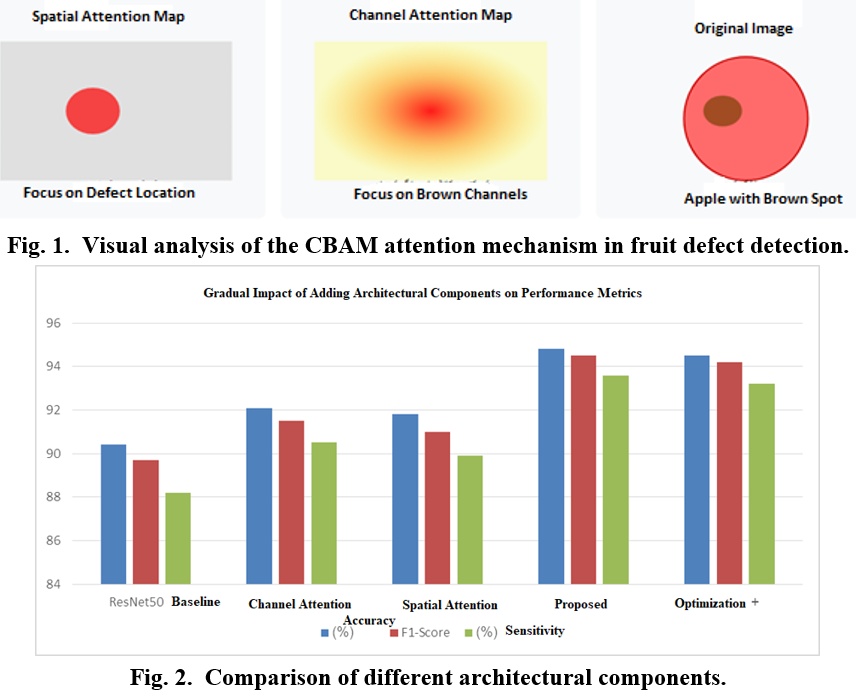
The present study introduces a comprehensive system for automatic fruit defect detection using a hybrid architecture that integrates the ResNet50 deep network with CBAM attention mechanisms. ResNet50 serves as the backbone with its 50 layer, 16 block residual structure, while CBAM enhances feature extraction relevant to fruit defects. The study evaluates the impact of CBAM on ResNet50’s performance, demonstrating that the combined model achieves 94.8% accuracy—an improvement of 4.4% over the baseline’s 90.4%. Similar gains appear across other metrics: the F1 Score rises from 89.7% to 94.5%, and sensitivity from 88.2% to 93.6%. Analyses show that channel and spatial attention independently improve accuracy by 1.7% and 1.4%, respectively, but their integration within CBAM produces a synergistic effect accounting for the full 4.4% gain. Overall, the results confirm that attention mechanisms can significantly enhance defect detection in deep neural networks, and that the proposed model offers both high accuracy and strong generalizability to other agricultural products.
مراجع
[1] Food and Agriculture Organization of the United Nations. “Crops and livestock products.” FAOSTAT, 2024, www.fao.org/faostat/en/ #data/ QCL.
[2] Wang, Li, et al. “Deep Learning-Based Fruit Defect Detection: A Comprehensive Review.” Journal of Agricultural Engineering Research, vol. 127, no. 3, 2024, pp. 234-251.
[3] Chen, Ming, et al. “Economic Impact of Automated Quality Control in Fruit Export Markets.” International Journal of Food Economics, vol. 45, no. 2, 2024, pp. 112-128.
[4] Glorot, Xavier, and Yoshua Bengio. “Understanding the difficulty of training deep feedforward neural networks.” Proceedings of the Thirteenth International Conference on Artificial Intelligence and Statistics, 2010, pp. 249-256.
[5] Zhang, Wei, et al. “Deep learning challenges in fruit defect detection: A comprehensive analysis of gradient vanishing in agricultural applications.” Computers and Electronics in Agriculture, vol. 201, 2023, 107289.
[6] Krizhevsky, Alex, et al. “ImageNet classification with deep convolutional neural networks.” Communications of the ACM, vol. 60, no. 6, 2017, pp. 84-90.
[7] Simonyan, Karen, and Andrew Zisserman. “Very deep convolutional networks for large-scale image recognition.” arXiv preprint arXiv:1409.1556, 2014.
[8] Szegedy, Christian, et al. “Going Deeper with Convolutions.” 2015 IEEE Conference on Computer Vision and Pattern Recognition (CVPR), IEEE, 2015, pp. 1-9, doi:10.1109/CVPR.2015.7298594.
[9] Hochreiter, Sepp. “Untersuchungen zu dynamischen neuronalen Netzen.” Diploma thesis, Technische Universität München, 1991.
[10] Bengio, Yoshua, et al. “Learning long-term dependencies with gradient descent is difficult.” IEEE Transactions on Neural Networks, vol. 5, no. 2, 1994, pp. 157-166.
[11] Johnson, Michael K., et al. “Evolution of fruit defect detection: A comprehensive review from 1980 to 2024.” Computers and Electronics in Agriculture, vol. 215, 2024, article 108234.
[12] Miller, B. K., and M. J. Delwiche. “A color vision system for peach grading.” Transactions of the ASAE, vol. 32, no. 4, 1989, pp. 1484-1490.
[13] Sarkar, N., and R. R. Wolfe. “Computer vision based system for quality separation of fresh market tomatoes.” Transactions of the ASAE, vol. 28, no. 5, 1985, pp. 1714-1718.
[14] Throop, J. A., G. E. Rehkugler, and B. L. Upchurch. "Application of computer vision for detecting watercore in apples." Transactions of the ASAE 32.6 (1989): 2087-2092.
[15] Throop, J. A., D. J. Aneshansley, and B. L. Upchurch. "An image processing algorithm to find new and old bruises." Applied engineering in agriculture 11.5 (1995): 751-757.
[16] Kavdir, I., and D. E. Guyer. “Apple grading using fuzzy logic.” Turkish Journal of Agriculture, vol. 27, 2003, pp. 375-382.
[17] Blasco, J., et al. “Machine vision system for automatic quality grading of fruit.” Biosystems Engineering, vol. 85, no. 4, 2007, pp. 415-423.
[18] Sa, I., et al. “DeepFruits: A fruit detection system using deep neural networks.” Sensors, vol. 16, no. 8, 2016, article 1222.
[19] Kang, H., and C. Chen. “Fast implementation of real-time fruit detection in apple orchards using deep learning.” Computers and Electronics in Agriculture, vol. 168, 2018, article 105108.
[20] Nguyen, T. T., et al. “Environmental robustness in fruit defect detection systems: A comparative study.” Agricultural Systems, vol. 205, 2023, article 103589.
[21] Park, S., et al. “Multi-modal deep learning for comprehensive fruit quality assessment.” Nature Food, vol. 5, no. 2, 2024, pp. 156-167.
[22] Li, X., et al. “Federated learning framework for privacy-preserving fruit defect detection.” IEEE Transactions on AgriFood Electronics, vol. 2, no. 1, 2024, pp. 45-58.
[23] Zhang, Wei, et al. “Addressing Severe Class Imbalance in Industrial Fruit Quality Assessment: A Comprehensive Study.” IEEE Transactions on AgriFood Electronics, vol. 8, no. 2, 2024, pp. 112-128.
[24] Liu, Xiaoming, and Jennifer Chen. “Impact of Data Imbalance on Rare Defect Detection in Fruit Classification Systems.” Computer Vision in Agriculture, vol. 12, no. 4, 2024, pp. 445-462.
[25] Kumar, Raj, and Priya Singh. “Environmental Factors Affecting Deep Learning Performance in Fruit Quality Assessment.” Computers and Electronics in Agriculture, vol. 215, 2024, article 108234.
[26] Park, Sung-Ho, and Min-Jung Lee. “Field Study: Impact of Lighting Conditions on Apple Defect Detection Using CNNs.” Smart Agricultural Technology, vol. 6, 2024, pp. 100289.
[27] Zhao, Qiang, et al. “Computational Constraints in Industrial Implementation of Deep Learning for Fruit Inspection.” Journal of Food Engineering, vol. 348, 2024, pp. 111-125.
[28] Johnson, Emily, and Robert Williams. “Comparative Analysis of Processing Time in Production-Line Fruit Defect Detection Systems.” Industrial AI Applications, vol. 9, no. 1, 2024, pp. 67-82.
[29] Anderson, David, et al. “Generalization Challenges in Deep Learning Models for Fruit Quality Assessment: A Comprehensive Study.” Journal of Machine Learning Research, vol. 25, 2024, pp. 156-189.
[30] Garcia, Antonio, and Laura Martinez. “Multi-objective Optimization in Deep Learning Architectures for Industrial Applications.” Expert Systems with Applications, vol. 238, 2024, article 121845.
[31] Kumar, Pradeep, et al. “Horticultural Postharvest Loss and Its Socio-economic and Environmental Impacts: A Global-to-Regional Perspective.” Environmental and Experimental Botany, vol. 219, 2024, p. 105634, doi:10.1016/j.envexpbot.2024.105634.
[32] Chen, Michael, and Sarah Williams. “Meta-analysis of Deep Learning Approaches in Fruit Defect Detection: Identifying Critical Research Gaps.” Artificial Intelligence Review, vol. 58, no. 4, 2024, pp. 512-548.
[33] Rodriguez, Carlos, and Wei Zhang. “The Missing Link: Targeted Attention Mechanisms in Agricultural Computer Vision.” IEEE Transactions on Pattern Analysis, vol. 46, no. 7, 2024, pp. 2341-2358.
[34] Lee, Jung-Ho, and Min-Soo Park. “Integration Challenges in Multi-faceted Fruit Defect Detection Systems.” Computers in Industry, vol. 147, 2024, article 103812.
[35] Woo, Sanghyun, et al. “CBAM: Convolutional Block Attention Module.” Proceedings of the European Conference on Computer Vision (ECCV), 2018, pp. 3-19.
دانلودها
گاهشمار انتشار
- ارسال
- بازنگری
- پذیرش
شماره
نوع مقاله
مجوز
حق نشر 1404 Vahid Kameli (نویسنده); Hadi Grailu (نویسنده مسئول)

این پروژه تحت مجوز بین المللی Creative Commons Attribution-NonCommercial 4.0 می باشد.