Providing an Intelligent Model for Predicting Student Academic Decline with Emphasis on Family Characteristics: A Case Study of Alborz Province
Keywords:
student academic decline, family characteristics, machine learning, academic decline predictionAbstract
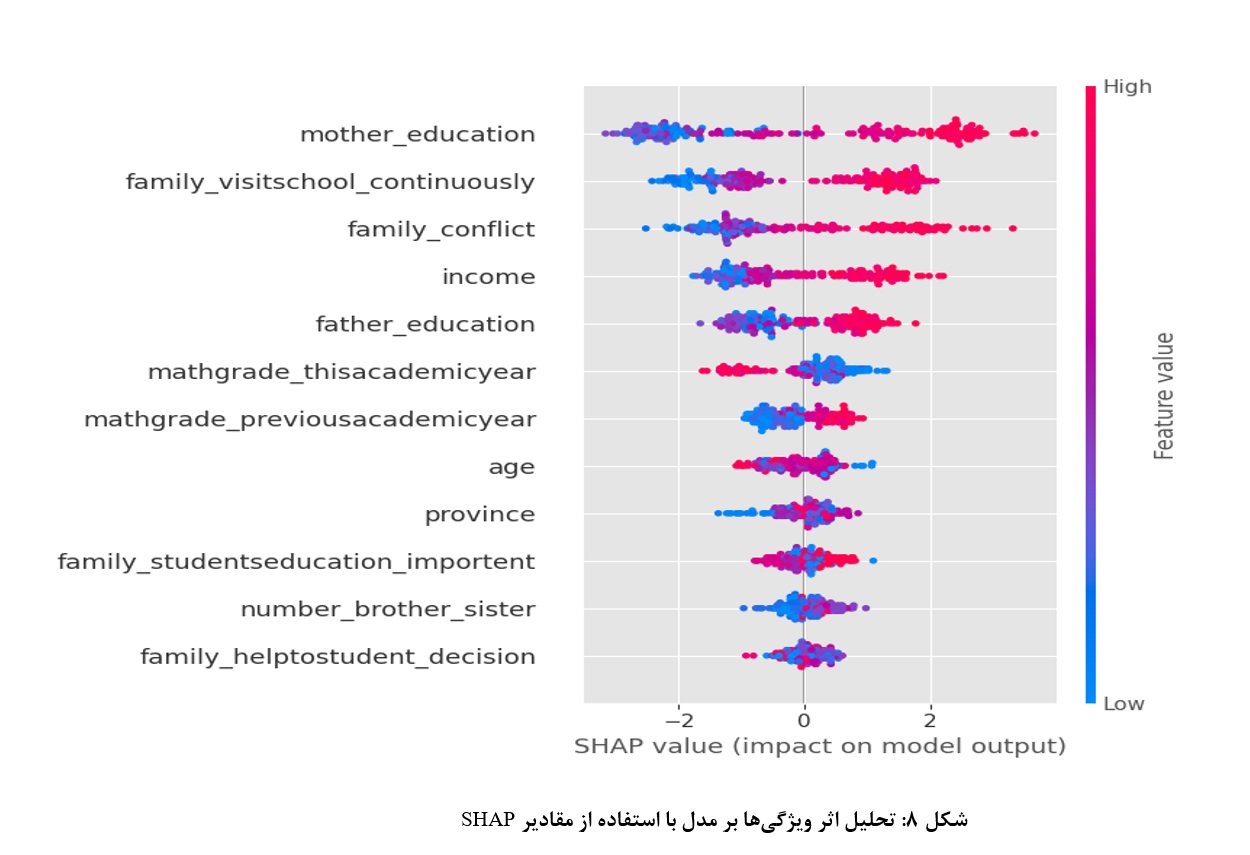
The education system, as one of the fundamental pillars of human development, plays a crucial role in fostering individual and social advancement. Student academic decline is one of the serious challenges in this field, with long-term individual and social consequences. Although numerous studies have been conducted globally, local research in this area remains limited; therefore, conducting a case study in Alborz Province can help fill this research gap. This study aimed to analyze and model student academic decline based on family indicators through a case study in Alborz Province. The research data were collected from primary and secondary schools in the province and included variables such as parents’ educational level, household income, parents’ occupations, and family structure. To design the predictive model for academic decline, four machine learning algorithms were applied: logistic regression, support vector machine (SVM) with an RBF kernel, random forest, and XGBoost. The results showed that among the tested models, the random forest algorithm performed best and achieved 98% accuracy in identifying complex relationships among the variables. For analyzing the relationships between family variables and academic decline, Spearman’s rank correlation coefficient was first used to examine statistical associations. Then, SHAP (SHapley Additive exPlanations) analysis was employed to interpret the decisions of the machine learning models and clarify the role of each variable. Based on the findings, mother’s education, household income, and father’s education were identified as the most significant factors contributing to academic decline. The results of this study can be highly effective in designing preventive educational policies and timely identification of at-risk students.
References
[1] Chen, Z., Cen, G., Wei, Y., & Li, Z. (2023). Student performance prediction approach based on educational data mining. IEEE Access, 11, 131260-131272. https://doi.org/10.1109/ACCESS.2023.3254123
[2] Salam, A., & Zeniarja, J. (2023). Classification of deep learning convolutional neural network feature extraction for student graduation prediction. Indonesian Journal of Electrical Engineering and Computer Science, 32(1), 335. https://doi.org/10.11591/ijeecs.v32.i1.335
[3] Xiong, Z., Li, H., Liu, Z., Chen, Z., Zhou, H., Rong, W., & Ouyang, Y. (2024). A review of data mining in personalized education: Current trends and future prospects. Frontiers of Digital Education, 1(1), 26-50. https://doi.org/10.3389/fode.2024.00026
[4] Lin, Y., Chen, H., Xia, W., Lin, F., Wang, Z., & Liu, Y. (2023). A comprehensive survey on deep learning techniques in educational data mining. arXiv preprint arXiv:2309.04761. https://doi.org/10.48550/arXiv.2309.04761
[5] Villar, A., & de Andrade, C. R. V. (2024). Supervised machine learning algorithms for predicting student dropout and academic success: A comparative study. Discover Artificial Intelligence, 4(1). https://doi.org/10.1007/s44163-023-00079-z
[6] Yousafzai, B. K., Khan, S. A., Rahman, T., Khan, I., Ullah, I., Ur Rehman, A., ... & Cheikhrouhou, O. (2021). Student-performulator: student academic performance using hybrid deep neural network. Sustainability, 13(17),9775. https://doi.org/10.3390/su13179775
[7] Pelima, L. R., Sukmana, Y., & Rosmansyah, Y. (2024). Predicting university student graduation using academic performance and machine learning: a systematic literature review. IEEE Access, 12, 23451-23465. https://doi.org/10.1109/ACCESS.2024.3361479.
[8] Jin X. Predicting academic success: machine learning analysis of student, parental, and school efforts. Asia Pacific Education Review. 2023 Nov 29:1-22. https://doi.org/10.1007/s12564-023-09915-4
[9] Suaza-Medina, M., Peñabaena-Niebles, R., & Jubiz-Diaz, M. (2024). A model for predicting academic performance on standardised tests for lagging regions based on machine learning and Shapley additive explanations. Scientific Reports, 14(1), 25306. https://doi.org/10.1038/s41598-024-76596-3
[10] Salehi, M., Pahlavan, M., & Shojaee, A. A. (2023). The Academic Failure Model of the Senior Students of Mazandaran Province based on the Socio-Economic Position and Family Social Capital with the Mediation of Family Chaos. Iranian journal of educational sociology, 6(3), 158-168. http://dx.doi.org/10.61186/ijes.6.3.158
[11] Fernández, A., Garcia, S., Herrera, F., & Chawla, N. V. (2018). SMOTE for learning from imbalanced data: progress and challenges, marking the 15-year anniversary. Journal of artificial intelligence research, 61, 863-905. https://doi.org/10.1613/jair.1.11192
[12] Shojaei Shamirani, R., Ebrahimzadeh, A., Norouzzadeh, R., & Shafigh, N. (2021). A meta-analytic review of some family, individual, and educational factors affecting academic failure among secondary school students. DOR: 20.1001.1.10174133.1400.37.1.2.3
[13] Badraoghli Tabrizi, Z., Jalili, S., & Ehsani, R. (2017). Presenting a model to reduce academic failure using a data mining approach (Case study: Technical and Vocational Schools of Tehran). National Scientific Document, Civilica. URL: [link not provided]
[14] Souki, S., Bagheri, N., Babakhani, N., & Mojtabaei, M. (2024, January 1). Presenting a predictive model of academic progress based on self-regulated learning and family cultural capital with the mediating role of attitude toward learning among second-grade high school students in Tehran. Journal of Curriculum and Behavioral Learning (JCBL), 1(1), 71–88.
[15] Shaker, Z., & Soleimani, T. (2020). Comparison of family dysfunction, quality of life, and academic burnout in students with and without learning disabilities. 6th National Conference on New Research in the Field of Educational Sciences and Psychology of Iran, Tehran. https://civilica.com/doc/1181364
[16] Ghodousi, M., Mirsaeidi, F., & Kousha, H. (2020). Prediction and analysis of students’ performance using data mining techniques to improve academic achievement. Educational Technology (Technology and Education), 14(4), 821–834. Available from: https://sid.ir/paper/402372/fa
[17] Samadi, R., & Raaei, M. (2018). Predicting factors influencing academic success of students using data mining techniques. 4th National Conference on Technology in Electrical and Computer Engineering, Tehran. https://civilica.com/doc/928954
[18] Silva, A. (2008). Using data mining to predict secondary school student performance.
[19] Hussain, M., Zhu, W., Zhang, W., & Abidi, S. M. R. (2018). Student engagement predictions in an e‐learning System and their impact on student course assessment scores. Computational intelligence and neuroscience, 2018(1), 6347186. https://doi.org/10.1155/2018/6347186
[20] Adekitan, A. I., & Salau, O. (2019). The impact of engineering students' performance in the first three years on their graduation result using educational data mining. Heliyon, 5(2). https://doi.org/10.1016/j.heliyon.2019.e01250
Publication Timeline
- Submitted
- Revised
- Accepted
Issue
Section
License
Copyright (c) 2025 محبوبه مولوی عربشاهی, جواد وحیدی, امیر پاس لاری (نویسنده)

This work is licensed under a Creative Commons Attribution-NonCommercial 4.0 International License.