A Hybrid Chaotic Gravitational Search Algorithm Based on Gower's Similarity Coefficient for Cellular Layout Design in Mass Customization Systems with Mixed-Type Data
کلمات کلیدی:
Mass Customization, Gower's Similarity Coefficient, Chaotic Gravitational Search Algorithm, Cellular Layout Design, Data Mining in Manufacturingچکیده
This research presents a novel hybrid methodology for designing cellular layouts in mass customization systems. The proposed method requires only production routing information and consists of three components: (1) Gower's similarity coefficient for mixed-type data, (2) gravity-based clustering for initial cell formation, and (3) a Chaotic K-best Gravitational Search Algorithm (CKGSA) for final layout optimization.
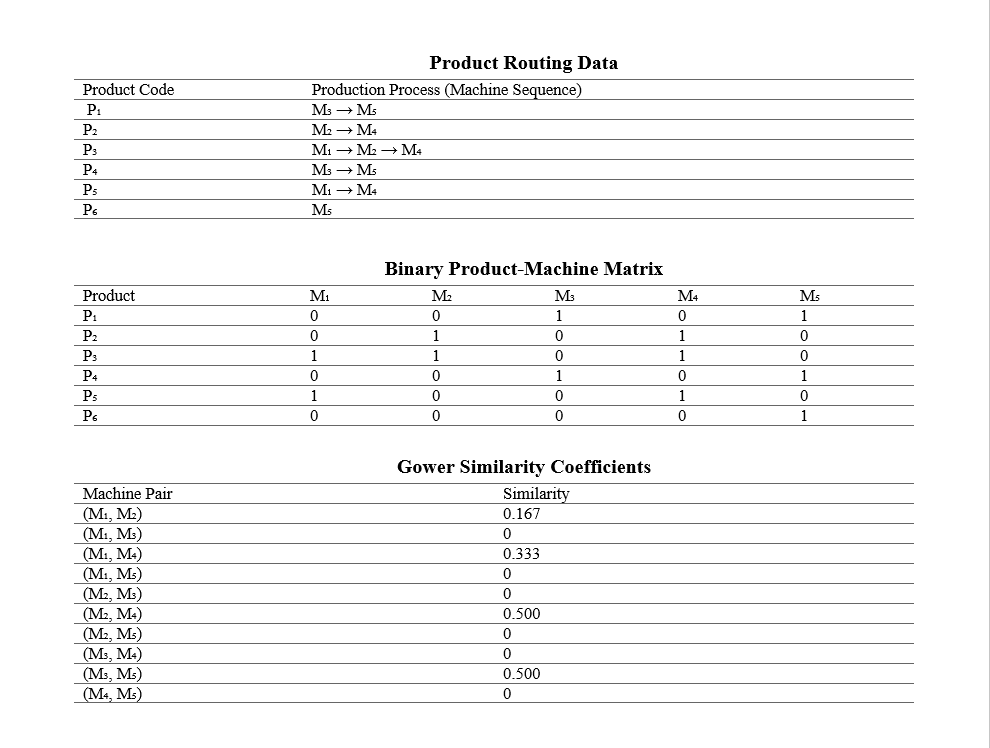
A hypothetical example with several products and machines was considered for validation. Results showed that Gower's coefficient successfully identified main machine clusters. The CKGSA significantly improved the fitness function, achieving zero inter-cell movement and considerably increasing intra-cell similarity. A systematic literature review confirmed that the combination of Gower's coefficient, gravity approach, and chaotic gravitational search is unique in the literature.
The main novelty lies at three levels: first application of Gower's coefficient in cellular layout problems, development of gravity-based clustering for virtual coordinate assignment, and presentation of an improved chaotic version of the gravitational search algorithm. By significantly reducing data requirements, the proposed method enables small and medium enterprises to implement cellular manufacturing systems quickly and cost-effectively.
مراجع
Ananto, P. K. F., Hsieh, C. C., & Mahendrawathi, E. R. (2022). Competition between online and offline retailer mass customization. Procedia Computer Science, 197, 709–717.
Bouchard, S., Gamache, S., & Abdulnour, G. (2023). Strategy using modularity tools to operationalize mass customization in manufacturing SMEs. Journal of Manufacturing Systems, 68, 367–379.
Deng, J., Sierla, S., Sun, J., & Vyatkin, V. (2023). Mass customization with reinforcement learning: Automatic reconfiguration of a production line. Robotics and Computer-Integrated Manufacturing, 80, 102456.
Duray, R., & Milligan, G. W. (1999). Improving customer satisfaction through mass customization. Quality Progress, 32(8), 60–66.
Gower, J. C. (1971). A general coefficient of similarity and some of its properties. Biometrics, 27(4), 857–871.
Heragu, S. S., & Kusiak, A. (1991). Efficient models for facility layout problem. European Journal of Operational Research, 53(1), 1–13.
Hui, G., Mamun, A. A., Masukujjaman, M., Makhbul, Z. K. M., & Ali, M. H. (2024). The relationship between mass customization and sustainable performance. Sustainability, 16(3), 250.
Jonsson, P., Öhlin, J., Shurrab, H., Bystedt, J., Muhammad, A. S., & Verendel, V. (2024). Root causes of material delivery schedule inaccuracy. International Journal of Production Economics, 260, 108899.
Krause, F., Görgen, J., De Bellis, E., Franke, N., Burghartz, P., Klanner, I. M., & Häubl, G. (2023). One-of-a-kind products: Leveraging strict uniqueness in mass customization. Journal of Marketing Research, 60(5), 1020–1034.
Lacroix, R., Seifert, R. W., & Timonina-Farkas, A. (2021). Benefiting from additive manufacturing for mass customization. CIRP Annals, 70(1), 189–192.
Momeni, M. (2011). Data clustering. Author publication.
Naldi, L. D., Galizia, F. G., Bortolini, M., Gabellini, M., & Ferrari, E. (2025). Unlocking mass customization through Industry 4.0. Applied Sciences, 15(13), 7160.
Osman, H., Azab, A., Hasan, R. B., & Baki, F. (2024). Mass customization using hybrid manufacturing and smart assembly. CIRP Annals, 73(1), 55–58.
Pallant, J. L., Sands, S., & Karpen, I. O. (2020). The 4Cs of mass customization in service industries. Journal of Services Marketing, 34(7), 835–849.
Pine, B. J. (1993). Mass customization: The new frontier in business competition. Harvard Business School Press.
Qian, Z., Chen, Y., & Xu, Y. (2024). Strategy design of fresh e-commerce pre-warehouse based on mass customization. Computers & Industrial Engineering, 192, 110180.
Rashedi, E., Nezamabadi-pour, H., & Saryazdi, S. (2009). GSA: A gravitational search algorithm. Information Sciences, 179(13), 2232–2248.
Rather, S. A., & Bala, P. S. (2020). Levy flight and chaos theory-based gravitational search algorithm. Journal of Intelligent & Fuzzy Systems, 39(4), 1–15.
Sanchez, R. (2002). Fitting together a modular approach. Manufacturing Engineer, 81(5), 216–218.
Soufi, M. (2009). Quantitative techniques for factory management and industrial plant layout. Iliya Cultural Publication.
Strong, M. B. (2003). Tools and metrics for evaluating modular products [Master's thesis, Brigham Young University].
Tompkins, J. A., & Reed, J. R. (1976). An applied model for the facilities design problem. International Journal of Production Research, 14(5), 583–595.
Tsutsui, S., Kaihara, T., Kokuryo, D., Fujii, N., & Harano, K. (2022). Production scheduling with dynamic parts allocation for mass customization. Procedia CIRP, 107, 882–887.
Zhu, Z., Huang, Y., Ji, W., Zhu, J., & Wang, W. (2024). A parametric design framework for mass customization of bicycle helmet. Heliyon, 10, e27409.
دانلود
گاهشمار انتشار
- ارسال
- بازنگری
- پذیرش
شماره
نوع مقاله
مجوز
حق نشر 1404 Mansour Soufi (نویسنده مسئول); Mahdi Homayounfar, Mehdi Fadei (نویسنده)

این پروژه تحت مجوز بین المللی Creative Commons Attribution-NonCommercial 4.0 می باشد.