A Hybrid Fuzzy Model for Enhancing Strategic Scenario Design by Integrating AI Algorithms and Foresight Methodologies
کلمات کلیدی:
Software Testing, Test Case Prioritization, Machine Learning Techniques, Unit Test Optimization, Metaheuristic Methodsچکیده
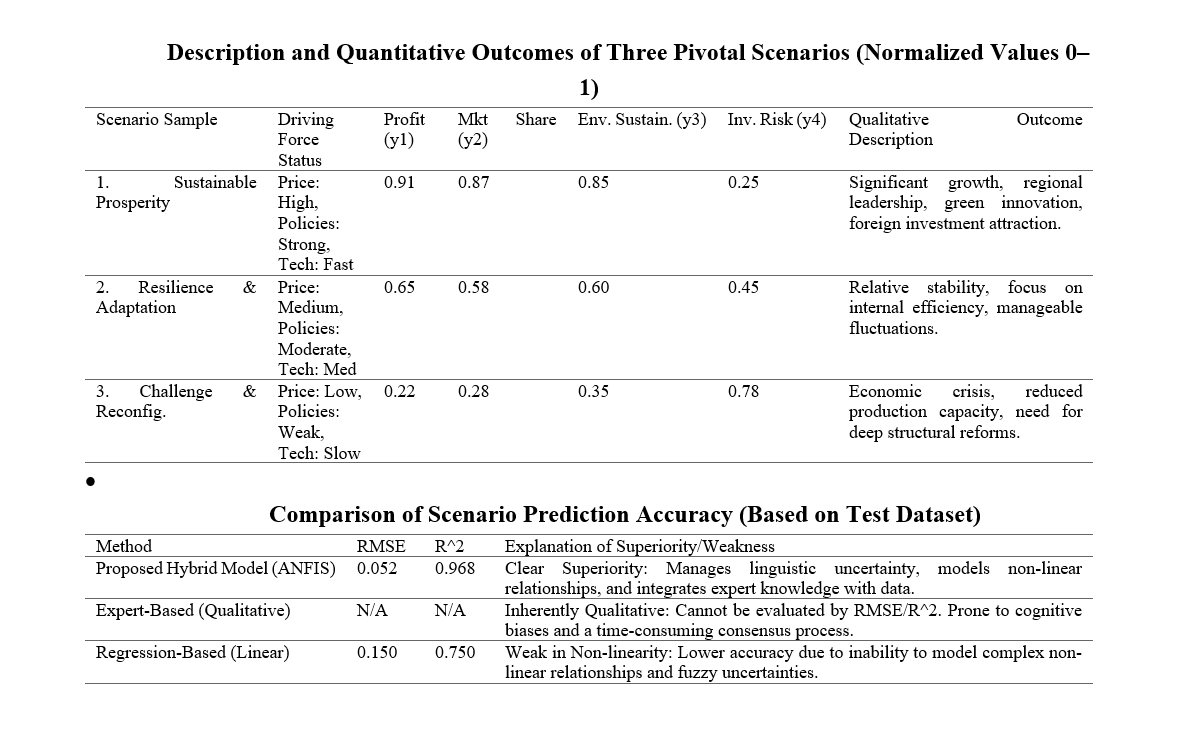
Designing strategic scenarios is crucial for ensuring organizational resilience and competitiveness in today's volatile business environments. Scenario design has matured as a cognitive tool for exploring and preparing for plausible futures. Recent studies emphasize organizational and procedural aspects, such as leadership's role and the importance of stakeholder engagement in creating meaningful scenarios. This study introduces a novel approach by developing a Hybrid Fuzzy Model that intelligently integrates advanced Artificial Intelligence (AI) algorithms with foresight methodologies and expert knowledge. The model is built upon a robust quantitative-qualitative framework, employing techniques such as fuzzy logic, the Adaptive Neuro-Fuzzy Inference System (ANFIS), the Delphi method, and multi-objective Pareto optimization. A critical review of the literature from 2019–2024 identified significant gaps in existing approaches, which this model is designed to address. For operational validation, the model was implemented using simulated real-world data from Iran's strategic zinc industry. Comprehensive quantitative and qualitative validation results—including model performance metrics (R^2 = 0.968), Delphi convergence charts, optimized membership functions, and the Pareto front of optimal scenarios—confirm the model's high accuracy and remarkable effectiveness in managing complex uncertainties and generating robust strategic scenarios. This research provides managers and policymakers with an advanced analytical tool to make more informed, flexible, and robust strategic decisions amidst future complexities, thereby ensuring organizational agility.
مراجع
Arasteh, B., Hosseini, S.M.J. (2022). Traxtor: An Automatic Software Test Suit Generation Method Inspired by Imperialist Competitive Optimization Algorithms. Journal of Electronic Testing, 205-215.
Bertolino, A., Guerriero, A., Miranda, B., Pietrantuono, R., & Russo, S. (2020). Learning-to-rank vs ranking-to-learn: Strategies for regression testing in continuous integration. 2020 IEEE/ACM 42nd International Conference on Software Engineering (ICSE), Seoul, Korea (South).
Khambam, S. K. R., Kaluvakuri, V. P. K., & Peta, V. P. (2022). Optimizing Cloud-Based Regression Testing: A Machine Learning-Driven Paradigm for Swift and Effective Releases. Available at SSRN 4927238.
Konidena, B. K., Bairi, A. R., & Pichaimani, T. (2021). Reinforcement Learning-Driven Adaptive Test Case Generation in Agile Development. American Journal of Data Science and Artificial Intelligence Innovations, 1, 241-273.
Lachmann, R. (2018). Machine learning-driven test case prioritization approaches for black-box software testing. The European test and telemetry conference, Nuremberg, Germany,
Lonetti, F., & Marchetti, E. (2018). Emerging Software Testing Technologies. In. Elsevier.
Marijan, D. (2023). Comparative study of machine learning test case prioritization for continuous integration testing. Software Quality Journal.
Muhammad, A. (2024). AI-Driven Testing Automation: Harnessing Machine Learning for Intelligent Test Case Creation and Predictive Defect Analysis. International Journal of Artificial Intelligence and Applications, 9(3), 22-35.
Mukherjee, R., & Patnaik, K. S. (2021). A survey on different approaches for software test case prioritization Journal of King Saud University – Computer and Information Sciences 1041–1054 1040pl.
Pandhare, H. V. (2025). Future of software test automation using ai/ml. International Journal Of Engineering And Computer Science, 13(05).
Ramachandran, S. (2026). Leveraging AI-driven multi-agents for next-generation software testing: a lattice-based cross-industry automation framework. International Journal of Information Technology, 1-8.
Ramzan, H. A., Islam, K., Hussain, M. A., Monim, R. M., Asad, S. M., & Ramzan, S. (2026). Data-Driven Test Case Prioritization (DD-TCP): A Machine Learning Framework for Intelligent Software Quality Assurance. Computers, Materials, & Continua, 88(1).
Sakhrawi, Z., Labidi, T. (2024). Test case selection and prioritization approach for automated regression testing using ontology and COSMIC measurement. Automated Software Engineering.
Sivaraman, H. (2020). Machine learning for software quality and reliability: Transforming software engineering. Libertatem Media Private Limited.
Sugave, S. R., Kulkarni, Y.R., Jagdale, B. et al. (2025). Fault-Aware Test Case Prioritization in Software Testing Using Jaya Archimedes Optimization Algorithm. Journal of Electron Test.
Wang, X., Zhang, S. (2023). Cluster-based adaptive test case prioritization. Information and Software Technology, 107339.
دانلودها
گاهشمار انتشار
- ارسال
- بازنگری
- پذیرش
شماره
نوع مقاله
مجوز
حق نشر 1404 Eisa Naji, امیر نجفی, Reza Ehtesham Rasi (نویسنده)

این پروژه تحت مجوز بین المللی Creative Commons Attribution-NonCommercial 4.0 می باشد.